
Soulmate Signs in Palm Reading: 7 Clues of Deep Compatibility
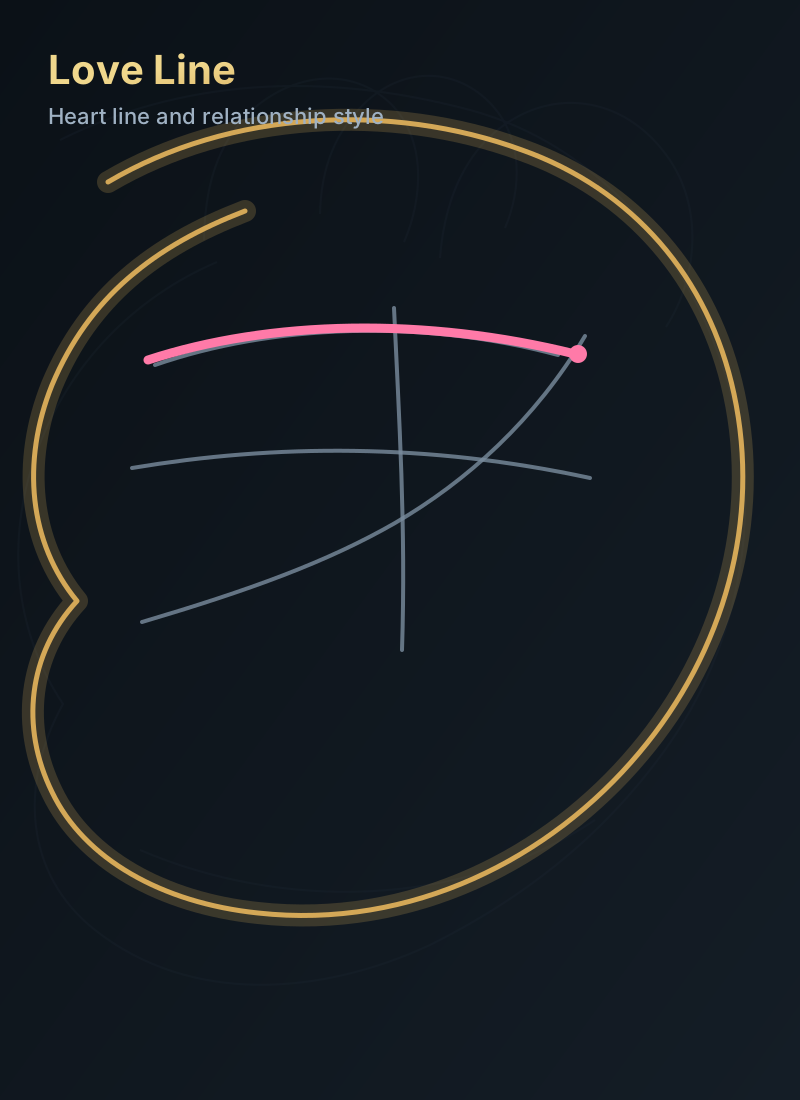
Searching for soulmate signs in palm reading? This guide covers seven commonly discussed clues around the heart line and relationship area, how to recognize each one on your own hand, and how readers traditionally interpret them. The goal is to help you read your palm honestly — as a portrait of your emotional patterns, not as a forecast of who is coming.
1) Clear Heart Line
The heart line is the uppermost horizontal line on the palm, running below the fingers from the edge near the pinky toward the index or middle finger. In traditional palmistry it is read as the line of feeling, attachment, and emotional expression. A "clear" heart line is one with a single, well-defined main path — visible without squinting and continuous across most of its length.
To find it on your own palm, hold the hand open in good light and look for the most prominent horizontal line near the top. A clear version is one you can trace from edge to ending without losing track. It does not need to be deeply etched — clarity here is more about being uncluttered than dramatic. Lines crowded with crosshatching or chains read very differently.
The interpretation is emotional clarity: a sense of knowing what you feel and being able to express it without too much internal scrambling. In a soulmate context this is read as the ability to be honest with a partner — to name affection, hurt, or doubt while it is still fresh, instead of letting it accumulate. People with this sign are often described as those who do not require partners to read their minds.
One soft caution: a very clear, very simple heart line can be read as emotionally direct to the point of bluntness. Soulmate-friendly clarity has a little texture to it — small branches, slight curves — suggesting a person who is honest but also capable of nuance and care in delivery.
2) Balanced Heart Line Curve
The shape of the heart line is read separately from its clarity. Traditional palmistry distinguishes a curved heart line that arcs gently up toward the fingers from a straighter line that runs nearly level. A balanced curve sits between the two — present and visible, but not extreme in either direction. It is the shape most associated with steady long-term partnership.
To recognize it, look at where your heart line ends compared to where it began. A balanced curve usually finishes a bit higher than it started, with a smooth lift rather than a sharp hook. Compare it side by side with both of your hands; many people have a more curved line on one hand and a straighter one on the other, which is itself meaningful.
The reading is emotional warmth balanced with self-possession — the ability to be openly affectionate without losing your own footing in a relationship. Readers often link this curve with people who can love generously without becoming dependent, and who can hold space for a partner's hard moments without absorbing every wave. It is one of the more practically useful signs for long partnerships.
The counterbalance: shape suggests default style, not effort or maturity. A perfect balanced curve in a person who has not done their own emotional work will still struggle in partnership, and a sharply curved or very straight line in a self-aware person can lead to a beautifully balanced relationship. The hand describes tendency, not outcome.
3) Upward Branches Toward Index Finger
Upward branches are small lines that lift away from the heart line and travel toward the fingers, often pointing toward the index finger or the space between index and middle. They are typically short and finer than the main heart line, and most palms have at least a few. In traditional palmistry, an upward branch toward the Mount of Jupiter (under the index finger) is read as a marker of idealism and high standards in love.
To spot them, examine the upper edge of your heart line under bright light, ideally with a magnifier or a phone camera. The branches you are looking for clearly leave the main line at a soft upward angle and travel several millimeters toward the fingers. Tiny crosshatching or chaotic small lines do not count — readers want to see deliberate-looking forks.
The soulmate interpretation is values-driven love: a tendency to look for partners who share principles and growth direction, not only chemistry. People with this sign are often described as those who would rather wait for the right fit than settle into a comfortable but value-mismatched relationship. It is a sign about depth-of-fit more than length-of-search.
A useful caution: a high-standards reading without other softening signs can tip into perfectionism that pushes good partners away. Healthy versions of this sign usually appear alongside a balanced curve or a few downward branches, suggesting someone who holds standards but can also accept the imperfect humanness of a real person across years.
4) Well-Defined Relationship Zone
The "relationship zone" or "marriage line area" is the small section on the side of the palm just below the pinky finger, above the heart line. In classical palmistry, short horizontal lines here are read as significant bonds — the kind of relationship that leaves a mark on someone's life, regardless of whether it ends in marriage. A well-defined zone has one or two clean lines rather than a tangle of fine ones.
To examine it, turn your hand sideways so you can see the edge below the pinky. Look for short horizontal lines between the base of the pinky and the heart line. A well-defined version typically shows one prominent line, sometimes accompanied by a fainter one. Many fine, short lines all stacked together tell a different story and are usually read as emotional sensitivity rather than committed bonds.
The interpretation is the capacity for significant attachment — being able to let someone matter enough that the relationship leaves a real shape on your life. In a soulmate reading this is taken as a sign of someone willing to commit at depth, even if the form (marriage, long partnership, life-defining friendship) varies. The line is about meaning, not legal status.
The honest counterbalance: a well-defined relationship zone in someone who has not yet had a major bond is often read as readiness rather than fulfillment. The line is associated with the capacity to attach, and many palms show it before the person has actually had the experience that would deepen it. Absence of a clear line is not a closed door — it is often read as a different attachment style, not no attachment at all.
5) Few Major Interruptions
Interruptions on the heart line and surrounding relationship area include large breaks, deep islands (small loops in the line), and sharp crosses. A heart line with few major interruptions is one whose main path is not heavily disturbed by these features. It does not need to be perfectly smooth — most heart lines have some texture — but the dominant impression is of a continuous line.
To check yours, trace the line slowly from the pinky side toward the index side and notice anywhere it clearly stops, loops, or is crossed at a sharp angle. Tiny ripples and shallow chains are normal. Major interruptions are the ones you would describe as such on first look. If you find none, that is the pattern this sign is referring to.
The reading is emotional steadiness over time — fewer dramatic resets in how someone approaches love. In a soulmate context this is interpreted as the ability to keep showing up the same person across years, so a partner can actually rely on who they are getting. It is one of the most underrated relationship traits, because it looks unglamorous from the outside.
A genuine caution: interruptions are not bad. Many people with deeply committed long relationships have visible breaks or islands on the heart line, often read as the lessons that built the depth they later brought into partnership. A perfectly uninterrupted line is sometimes read as someone who has not yet been emotionally tested, so this sign is most informative once a person has actually navigated heartbreak.
6) Harmony Between Head and Heart Indicators
This sign asks you to compare the head line and the heart line on the same palm. The head line runs across the middle of the palm, and the heart line runs above it. "Harmony" means the two lines look related to each other — similar in clarity, with a balanced spacing between them, and without one dominating the other dramatically. It is read as a hand whose feeling and thinking work together.
To assess it, look at the two lines together. Are they roughly comparable in depth? Is the space between them reasonable — not crowded, not unusually wide? Does one line look healthy while the other looks fragmented? A harmonious pair is one where neither line overpowers the other and they appear to belong to the same person.
The interpretation is internal alignment — the ability to feel something deeply and also think about it clearly without one canceling the other. In partnership, this often shows up as people who can stay emotionally engaged during a hard conversation rather than retreating into pure logic, and who can also pause to think during an emotional moment rather than only reacting. Both moves are needed for a relationship to last.
The counterbalance worth naming: very wide spacing between the head and heart lines is sometimes read as openness and tolerance — sometimes useful, sometimes a tendency to give too much benefit of the doubt. Very narrow spacing can be read as caution in love. Harmony is the middle reading; most other shapes are simply different relational temperaments rather than problems.
7) Supportive Secondary Lines
Beyond the major lines, the palm often shows finer secondary lines — short verticals near the base of the fingers, gentle influence lines near the life line, and supporting marks around the marriage line area. In the relationship reading, these are treated as backing vocals: not the main melody, but the harmony that makes the song fuller. They are most often read as signs of bonding, mutual support, and shared growth.
To find yours, scan the palm closely for short, faint lines near the major lines you have already identified. Influence lines often run roughly parallel to the life line and are read as significant people who have shaped your emotional life. Small supportive lines near the heart line are read as relationships that strengthen rather than test it.
The interpretation is the felt presence of people who support your emotional life — a partner, but also family, close friends, mentors. In a soulmate reading, this sign is taken as evidence that the person does not have to bear everything alone, which makes them a healthier partner in turn. Strong primary relationships almost always rest on a wider support web.
A balancing note: a palm crowded with too many small lines is sometimes read as emotional sensitivity that is hard to soothe. The healthiest version of this sign is a small number of clearly visible secondary lines, not a dense mesh. As with the other signs, the goal is texture, not maximum line count.
Reading Soulmate Signs Together: Pattern vs. Single Mark
Any one of the seven signs above, found on its own, is too thin to support a confident soulmate reading. Traditional palmistry assembles patterns. A clear heart line with no balanced curve, no upward branches, and no defined relationship zone reads very differently from the same clear heart line in the company of all those features. The constellation matters more than any individual star.
A practical way to read your own palm is in groups of three. Heart line clarity plus balance plus interruption count tells you about your inner emotional weather. Upward branches plus a defined relationship zone plus harmony with the head line tells you about how you actually move into commitment. Reading in groups keeps you from over-weighting one line you happen to like or dislike on your hand.
It is also useful to read what is missing. A palm with strong commitment markers but a fragmented heart line might point to someone who can stay in a relationship but struggles to be emotionally present inside it. A palm with a beautiful heart line but no defined relationship zone might point to deep capacity for love that has not yet been pointed at one person. The absences are part of the portrait.
When the Heart Line Looks Conflicting
Many readers see signs that seem to contradict each other — a clear heart line broken by a deep island, a balanced curve with multiple interruptions, a strong relationship zone on a hand whose heart line looks fragmented. These are not misreadings. They almost always describe a real internal complexity rather than a confused palm.
The honest interpretation of conflicting signs is that more than one truth is operating at once. A clear heart line with major interruptions, for example, is often read as an emotionally honest person who has been through real reshaping experiences — both true, neither canceling the other. The growth direction such a palm suggests is integrating those experiences rather than pretending they did not happen.
If your palm shows almost none of the seven signs above, it does not mean a soulmate is unavailable. It usually means the traditional markers of pair-bonded love are not the dominant story your palm is telling, and your relational strengths may show up in other forms — close friendships, family bonds, creative collaborations. Use this guide as one frame among several.
Soulmate Signs in Both Partners: Comparing Hands
Compatibility readings in classical palmistry look at both partners' hands together, but they are not looking for matching lines. They are looking for complementary patterns. Two very curved heart lines in a couple can read as warm but emotionally chaotic; two very straight ones can read as stable but distant. Often the most enduring pairings combine one of each, so warmth and steadiness can balance.
When comparing hands, pay attention to the pace at which each person opens up. Heart line clarity and the relationship zone together suggest emotional pacing — how quickly someone moves from interest to attachment. Big mismatches here are not deal-breakers, but they are worth knowing about, because they explain a lot of early-relationship miscommunication that otherwise feels personal.
Finally, look at how each partner's head line interacts with their own heart line. A couple who can each individually balance feeling and thinking tends to have an easier time when the relationship hits friction, regardless of how their lines compare to each other's. Internal harmony in each person almost always matters more than line-for-line resemblance between the two palms.
FAQ
Can palm reading identify a soulmate?
Not a specific person. It can indicate relationship tendencies and compatibility patterns for reflection, but it cannot name or predict an individual.
Which lines matter most?
Most readers focus on the heart line, the relationship area below the pinky, and the supporting secondary lines around them. The harmony between heart and head lines is also studied.
Are soulmate signs predictive?
No. They are interpretive and for entertainment. Real outcomes depend on behavior, communication, and shared values over time.
Can soulmate signs change over time?
The heart line itself is largely stable, but small marriage lines and influence lines can shift subtly through major emotional periods. Many palmists treat these minor lines as the palm tracking your relationship history rather than predicting it.
Should I check both hands for soulmate signs?
Yes. Traditional palmistry reads the non-dominant hand for inherited emotional tendencies and the dominant hand for the patterns you have actually lived. Comparing both gives a fuller picture than either alone.
Do soulmate signs need to match my partner's palm exactly?
No. Compatibility readings look for complementary patterns, not identical lines. Many strong partnerships pair very different heart lines, and the dynamic between them is more meaningful than the resemblance.